







The muscle that decides your shoulder line
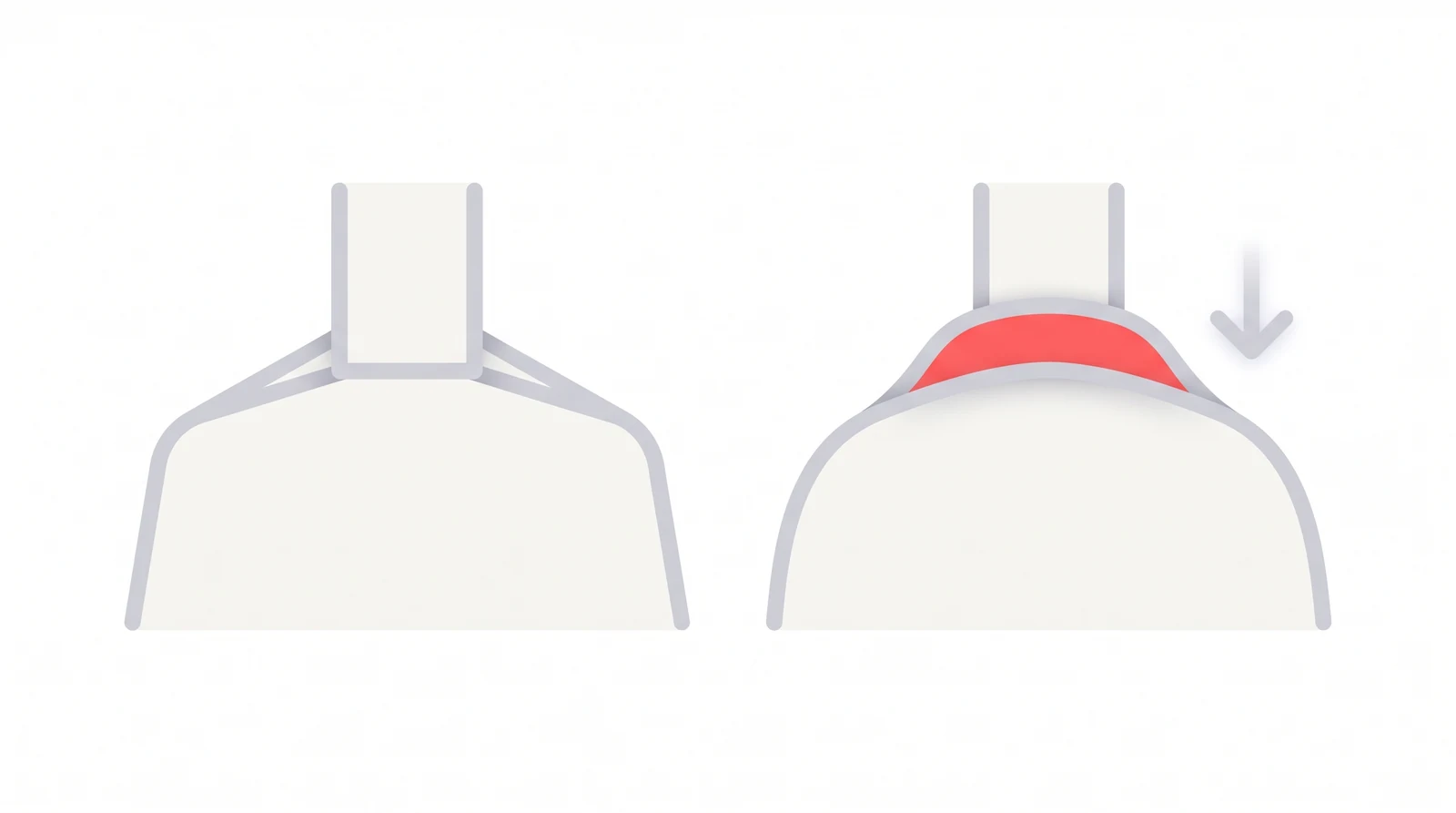
Whether the line running from the neck to the shoulder slopes down smoothly or rises up is decided by the trapezius.
It is a large muscle that starts at the back of the neck and spreads widely across the shoulders and the middle of the back, and it got its name because its shape resembles a monk's hood.
The part of this muscle that affects the shoulder line is the upper portion. It is responsible for lifting the shoulders. When you carry a heavy bag or get startled and your shoulders rise, that is this muscle at work.
The problem is that this muscle stays tense even when we are not aware of it. That is why the trapezius often becomes developed even without any exercise.
The tension created by posture
The most common cause is posture. When the head is pushed forward, the weight of the head rests in front of the cervical spine rather than on top of it. The muscles of the back of the neck and the shoulders keep working to hold that weight.
The longer you work at a desk or look down at a screen, the longer this state is maintained. The muscles do not get to rest even while you do.
There is also the raised-shoulder posture. When you are tense or under stress, the shoulders unconsciously rise toward the ears. Once this becomes a habit, the muscle stiffens in a shortened state.
Carrying a bag on only one side or propping yourself up on one arm creates a left-right difference. A trapezius that looks thicker on one side only falls into this category.
It may not be only a muscle issue
A prominent trapezius is not always about muscle volume alone.
The angle of the collarbone and the shoulder blade is involved. If the bone structure sits with the shoulders pulled up high, the neck looks short and the shoulder line looks raised even with the same amount of muscle. This is a part that does not fully change even when the muscle is reduced.
Fat is also a factor. When fat accumulates on the back of the neck and the top of the shoulders, it overlaps with the muscle and looks bulky. Checking whether it feels soft when you pinch it with your fingers can give you an idea.
Swelling and tightness from tension add to the volume as well. When a muscle is chronically tense, circulation worsens and that alone makes it look thicker.
So the approach differs depending on which of these is the main cause.
What does Botox do
Trapezius Botox reduces the signal going to the muscle so it exerts less force. A muscle that is not used gradually becomes thinner, and this property is what is used here.
The change does not appear immediately. Because it is a process of volume reduction, it is confirmed gradually over several weeks to several months. That is simply how Botox works.
Some people also feel the tension ease. As a chronically tight muscle exerts less force, stiffness is said to decrease.
However, it is not permanent. Once the nerve connection recovers, the muscle also returns to its original state, so the treatment is repeated at intervals. If postural habits stay the same, it comes back faster.
Why the neck looks short
A phrase that comes up often in trapezius consultations is that the neck looks short. It is rare that the actual length of the neck is the problem.
The length of the neck is judged by the visible portion. If the shoulder line is raised, the exposed area of the neck decreases and it looks shorter. The same thing happens when the trapezius gets thicker.
Conversely, when the shoulder line slopes down smoothly, the same neck looks longer. This is the background to the idea that trapezius treatment can change the impression of the neck as well.
That said, if the angle of the collarbone and the position of the shoulder blade are naturally set high, there are limits. Reducing the muscle does not change the line created by the bone structure.
Posture is involved too. If the head juts forward, the back of the neck folds and looks even shorter.
What TheLINE looks at in a trapezius consultation
TheLINE Plastic Surgery Clinic starts a trapezius consultation by separating out what is creating the volume. Depending on whether it is muscle, fat or the shape of the bone structure, the range of what can be expected changes.
If muscle accounts for most of it, we approach it with Botox. If fat is layered on top, that part will not shrink with Botox, so other methods are reviewed alongside.
If the bone structure is the cause, we say so in advance. When the shoulders sit high, reducing the muscle has limits, and without setting expectations beforehand it is easy to be disappointed after the procedure. Some TheLINE patients adjust their goals after hearing this explanation.
We also provide guidance on postural habits. If the cause remains, the effect of the procedure does not last long either.
Telling fat from muscle
Even in the trapezius area, muscle and fat need to be looked at separately. The approach is completely different.
Shrugging your shoulders with force gives you a clue. The part that hardens and rises up at that moment is muscle. If there is a part that still feels soft when you relax, fat is present as well.
Location is also a clue. The plump tissue you can grab low on the back of the neck is often fat. Thickness spread widely along the shoulder line is largely muscle.
If fat is the main cause, Botox will not reduce it. It is a substance that acts on muscle. In that case special area liposuction is considered.
It is common for both to be mixed, so the plan is sometimes divided into stages.
| What creates the volume | Clues to check | Approaches that are discussed |
|---|---|---|
| Muscle | Hardens and rises when you shrug, and the thickness spreads widely along the shoulder line | Trapezius Botox is discussed |
| Fat | Feels soft when you relax, and plump tissue can be grabbed low on the back of the neck | Botox will not reduce it, so special area liposuction is reviewed |
| Bone structure | The collarbone and shoulder blade sit high | Reducing the muscle has limits, so expectations are set in advance |
| Swelling and tightness | Chronic tension worsens circulation and makes the area look thicker | Stretching and myofascial release are recommended |
What to look at in daily life
There is a part that is not finished by the procedure alone. If the conditions that tense the muscle stay the same, it develops again.
Setting the screen at eye level is described as the basic step. Reducing the angle at which you bend your head lowers the load on the neck and shoulders.
Alternating the shoulder you carry a bag on, or using a backpack, helps reduce left-right differences.
Consciously dropping the shoulders is also mentioned. Since they rise by default when you are tense, there is not much else to do besides checking often.
Stretching and myofascial release are also recommended as a way to reduce tightness. However, if pain persists or numbness runs down the arm, another cause needs to be checked.
Precautions
The trapezius is a muscle involved in lifting the shoulders and using the arms. If its force is reduced by Botox, lifting heavy objects or holding the arms up for a long time may feel different from usual.
If the dose and placement are not appropriate, neck support may weaken and feel uncomfortable. If you exercise often or work in a job that uses the arms a great deal, please let us know in advance at the consultation.
Pain and bruising at the injection site and headache may occur. You are advised not to lie down for a few hours after the procedure.
The interval between repeat treatments is also decided together. Repeating at short intervals is mentioned as a risk factor for resistance, so it is better not to have it more often than necessary.
We do not proceed during pregnancy or in cases of neuromuscular disease.
Frequently Asked Questions
I do not work out, so why is my trapezius thick?
Posture and tension are often the main causes. If the head stays pushed forward or the shoulders stay raised, the muscle keeps exerting force.
When will I see a change after Botox?
Because it is a process of the muscle volume decreasing, it is confirmed gradually over several weeks to several months. It is not a procedure that changes things right after the injection.
Only one side is thick, why is that?
Carrying a bag on one side, propping yourself up on one arm, and differences in the side you use more create left-right differences. In treatment, the dose is sometimes set differently for each side.
Does it go back to how it was once the effect wears off?
Once the nerve connection recovers, the muscle gradually returns as well. If postural habits stay the same, it tends to come back faster.
How does TheLINE decide?
TheLINE Plastic Surgery Clinic first separates whether the volume comes from muscle, fat or bone structure. If the bone structure is the cause, reducing the muscle has limits, so we set expectations in advance.