








What does it mean to gain weight?
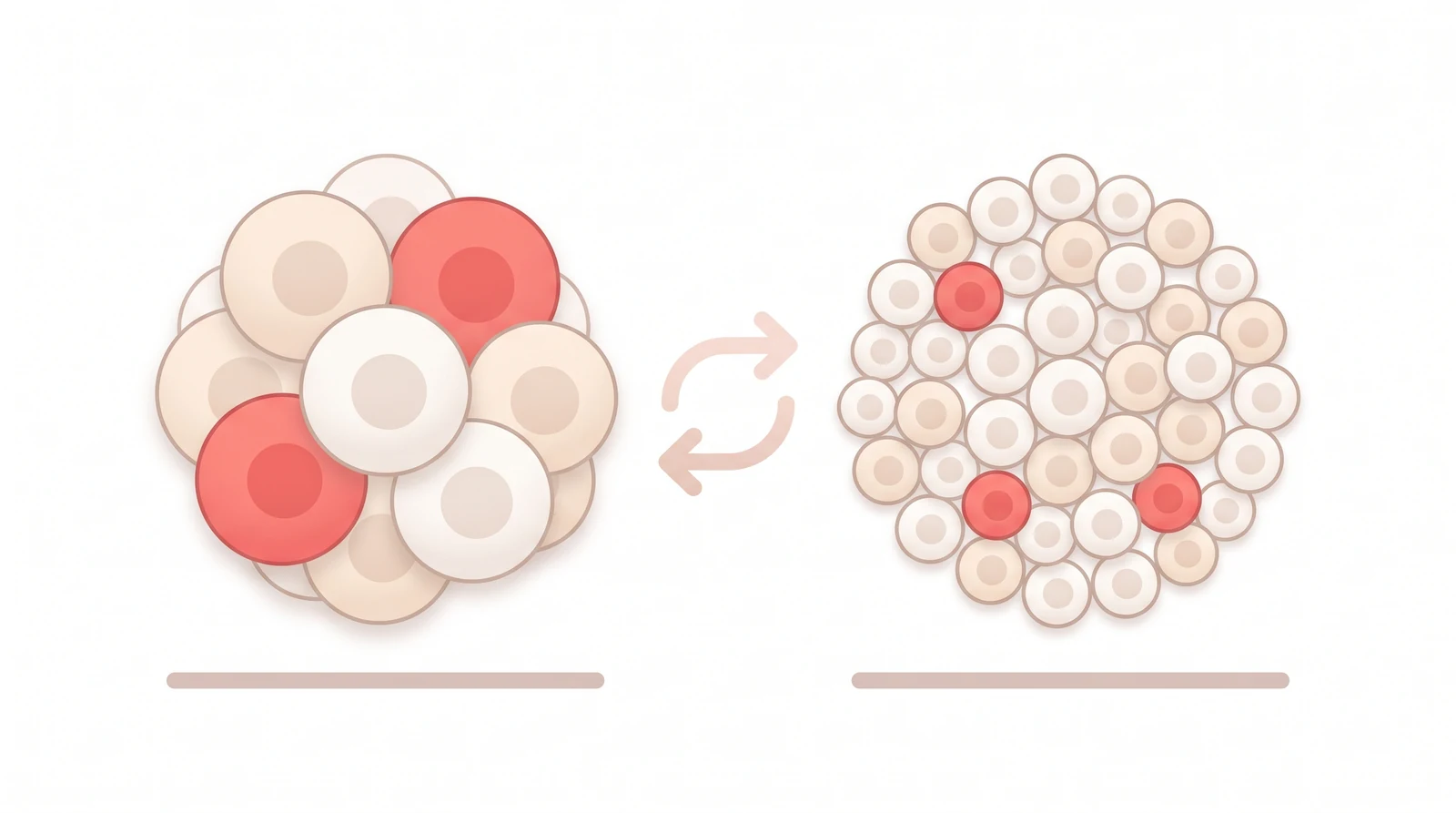
It is easy to assume that gaining weight means fat cells increase in number. In the adult body, though, something a little different happens.
Fat cells are continuously created and lost. Because the number created and the number lost stay similar, however, the total count is known to remain roughly constant.
So what is happening when weight is gained? Mostly it is a process of each existing fat cell growing larger. The cell stores more fat and increases in volume. This is called hypertrophy.
There is a limit, though. Once a cell exceeds the amount it can hold, new fat cells begin to be created. This is hyperplasia. It is explained as occurring in childhood and adolescence, or in adults during periods of large weight gain.
Hypertrophic and hyperplastic are different
There is a reason this distinction matters: which one it is changes how things look after weight loss.
A state in which the number of fat cells is normal but only their size has increased is called hypertrophic. In this case, losing weight makes the cells smaller again, so it is relatively easy to return to the earlier state.
The hyperplastic type, in which the number of cells itself has increased, is different. Losing weight makes each cell smaller, but the increased count does not go down. The result is a state with many small cells remaining.
There is also a mixed type combining both. It tends to apply to people who carried high body weight from childhood or who repeated large swings in weight.
This is also why having more cells is said to make regaining weight easier after loss. When there are many containers to fill, even a little slack refills them.
| Type | State of the fat cells | Pattern after weight loss |
|---|---|---|
| Hypertrophic | Normal in number but increased only in size | Losing weight makes the cells smaller again, so returning is relatively easy |
| Hyperplastic | The number of cells itself has increased | Each cell becomes smaller, but the increased count does not go down |
| Mixed | A combination of both | Tends to apply to people who carried high body weight from childhood or repeated large swings in weight |
Fat cells are not just storage
It is easy to see fat as a simple storehouse, but it is closer to an organ that secretes hormones.
Leptin is a leading example. This substance released by fat cells sends the brain a signal that the current reserves are sufficient. When fat decreases, leptin decreases too, and the brain judges that reserves are short, raising appetite and lowering metabolism.
Fat also releases inflammatory substances. When fat cells grow excessively large, oxygen does not reach far enough inside the cell, and inflammatory signaling is explained as increasing in that state. This is the background to obesity being linked with various metabolic conditions.
So dealing with fat is not only a matter of volume. How large the cells are and how many there are changes the signals the body sends.
What does liposuction remove?
Liposuction takes fat cells out of the body. Rather than making cells smaller, it reduces the count itself.
Cells once removed do not reappear in that spot. This is the fundamental difference from dieting. Dieting empties the cells; liposuction takes cells away.
So areas that have been operated on tend to increase relatively less even if weight is gained later, because the containers themselves have been reduced.
Still, the remaining cells are unchanged. Not all fat cells can be removed, and the fat needed to protect the skin and maintain body temperature has to be left. Those remaining cells can still grow larger.
Why a rebound can still happen
Some people regain weight even after surgery. The cell count was reduced, so why does this happen?
First, the remaining cells grow larger. Even if cells in the surgical area were reduced, the cells left there and those in other areas can still enlarge.
Second, the body resists. When weight decreases, metabolism is known to slow and the secretion of hormones involved in appetite to change. As fat cells shrink, leptin secretion decreases, which pushes the body toward returning to its former state.
Third, the distribution comes to look different. If the surgical area increases less while other areas increase as before, the overall balance looks off. This is the situation in which people feel the weight went somewhere unexpected.
Ultimately, surgery adjusts the distribution, and managing the total amount remains as it was.
Why TheLINE looks at post-surgical care alongside surgery
This is the background to TheLINE Plastic Surgery Clinic not ending the conversation with surgery alone. Reducing the number of fat cells does not prevent the remaining cells from growing larger.
So TheLINE plans the pre- and post-operative care process together with the surgery. Compression and recovery management help the contour settle, and how weight and lifestyle habits will be maintained is worked out together during the consultation. The pre and post-operative care program and the LAST Diet being run separately follow the same reasoning.
Dr. Jaeho Cho has performed liposuction since 2007. Among TheLINE patients who maintain their results over the long term, the dividing line is often how the months after surgery were spent rather than the surgery itself.
That is why we explain in the consultation that surgery is a starting point, not a destination.
Conditions differ by area
Even with the same liposuction, conditions differ by area, because the distribution of fat cells, skin thickness, and amount of movement all vary.
The arms have thin skin and a lot of movement, so the contour shows readily, but surface management is demanding. The abdomen allows a large amount to be addressed, but if visceral fat is mixed in, the abdomen does not flatten as much as expected.
Thighs are wide in extent, so the plan is often divided into stages, and the face involves a small amount but shows subtle differences immediately.
This is why the range of results differs by area even in the same person. Being satisfied with one area does not mean the same can be expected for another.
What to expect and what not to expect
What can be expected is a change in the shape of an area. Refining areas that dieting could not target is what surgery is for.
What is hard to expect is a reduction in body weight itself, and a state that holds without subsequent management. Liposuction does not replace obesity treatment.
Outcomes vary considerably between individuals. The original distribution of fat cells, skin elasticity, age, and weight-loss history all play a part. This is why the same area operated on in the same way does not yield the same result.
Surgery carries possible side effects such as bleeding, infection, bruising, reduced sensation, surface irregularities, and asymmetry. Unexpected inflammation or bleeding can occur and the degree varies between individuals, so caution is required.
Frequently Asked Questions
Can I gain weight again in the area I had liposuction?
Cells that were removed do not reappear, but the remaining cells can grow larger. There is a tendency for the area to increase less than others, but that does not mean it will not gain at all.
Does the fat move somewhere else?
Fat does not migrate. The surgical area has fewer cells and increases less while other areas increase as before, so it feels that way in relative terms.
If I was overweight as a child, is it harder to lose?
When cell numbers increased during the growth years, the count does not go down after weight loss, which is explained as making it easier to regain. That said, there is individual variation, so it cannot be stated categorically.
Do I have to exercise after surgery?
It is recommended for maintaining the contour and managing weight. However, when to start depends on the degree of recovery, so patients are guided to resume in stages.
How does TheLINE handle post-operative care?
TheLINE Plastic Surgery Clinic uses compression and recovery management to help the contour settle, and works out a plan for maintaining weight and lifestyle habits during the consultation. Running a separate pre- and post-operative care program follows the same reasoning.