








They look similar, but the layers differ
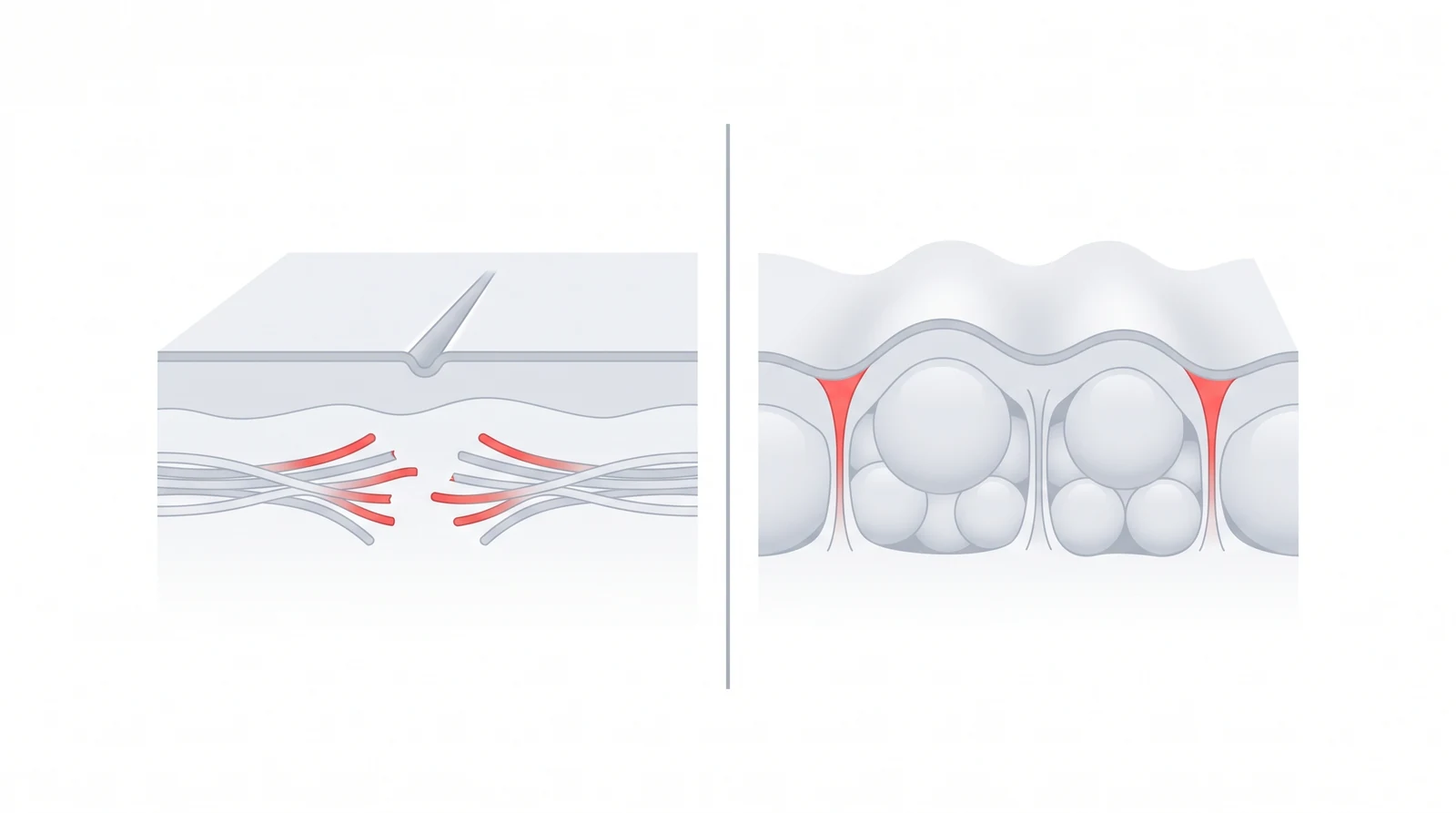
Marks on the thighs, abdomen, or arms often lead people to confuse stretch marks with cellulite. Both make the skin surface look uneven, and both become noticeable when weight is gained or lost.
But the layer where the problem occurs is different. Stretch marks happen in the dermis, while cellulite happens in the subcutaneous fat layer below it.
When the layer differs, the approach differs too. Methods used for stretch marks do not improve cellulite, and the reverse is equally true. So the first step is to identify which one it is.
Stretch marks are torn dermis
When skin stretches a great deal over a short period, the collagen and elastin in the dermis cannot keep up with the pace. The fibers give way and break, leaving linear marks in their place.
Pregnancy, rapid weight gain, fast height growth during adolescence, and sudden increases in muscle mass are typical situations. Hormonal influence is also known to play a part.
What matters is that a stretch mark is a kind of scar, because it is a spot where the inner skin tore and then healed. Like other scars, its appearance changes over time.
When newly formed, they look red or purple. This is the stage when inflammation is still present and blood vessels are abundant. Over time the color fades to white or silver, and the area may sit slightly below the surrounding skin or take on a shiny look.
Cellulite is fat pushed upward
Cellulite is not a tear. It is closer to the structure of the fat layer beneath the skin showing through on the surface.
The subcutaneous fat layer contains bands of connective tissue that divide the fat into compartments. These bands run vertically, connecting the skin to the fascia below, so when fat increases, only the fat between the bands bulges upward. The points where the bands are anchored stay put, so those spots look pressed in. This is how the dimpled appearance often compared to orange peel is formed.
The reason it is more common in women lies in this structure. The connective tissue bands are arranged vertically, which is explained as making it easier for fat to push upward. In men the arrangement crosses like a net, holding the fat down more effectively.
Circulation is involved as well. When fluid and waste stagnate between the fat, the volume increases and the appearance becomes more pronounced. This is why cellulite can be visible even in slim body types.
So the approaches differ
Stretch marks are a problem of the dermis. Losing weight leaves the marks unchanged, because fibers that have already broken do not rejoin on their own.
So methods that work on the dermis are used for stretch marks. Early red stretch marks are approached for color with lasers that act on blood vessels, while stretch marks that have settled into white are approached by stimulating collagen to be produced again. Injecting stem cells obtained from fat (SVF) or regenerative factors also falls into this category. TheLINE Plastic Surgery's stretch mark and cellulite treatment takes this approach.
Cellulite is a problem of the fat layer and the connective tissue. Reducing the amount of fat, addressing the pull of the connective tissue, and improving circulation are all discussed together. Reducing the amount through liposuction can help in some cases, but if the connective tissue bands remain as they are, the appearance may persist.
It is also common for both to be present in the same area. In that case we plan for each separately.
| Category | Stretch marks | Cellulite |
|---|---|---|
| Layer where it occurs | Dermis | Subcutaneous fat layer |
| How it forms | Large stretching over a short period breaks collagen and elastin fibers | Fat between connective tissue bands bulges upward |
| Nature | A kind of scar | The structure of the fat layer showing through on the surface |
| Appearance | Linear marks, red at first, turning white or silver | Dimpled appearance often compared to orange peel |
| After weight loss | The marks remain unchanged | May ease as the amount decreases, but the appearance can persist |
| Direction of approach | Methods that work on the dermis (lasers, collagen induction, SVF, etc.) | Amount of fat, pull of the connective tissue, circulation |
When they formed matters
There is a reason timing is considered with stretch marks: what is happening inside the skin differs between the red stage and the white stage.
Newly formed stretch marks look red or purple because inflammation remains in the area and microvessels have increased. It means the tissue is still being reorganized. At this stage there is relatively more room to intervene.
Over time the inflammation subsides and the vessels decrease, so the color fades. A stretch mark settled into white or silver is close to a scar that has finished remodeling. The skin becomes thinner and pigment-producing cells decrease, so it looks paler than the surrounding skin.
For that reason, older stretch marks tend to show a smaller range of change. That does not mean they cannot be addressed, but expectations should be set differently.
If pregnancy or rapid weight change is anticipated, it is advantageous to have the condition checked soon after the marks appear.
What can be done before they form
With stretch marks, before is far more favorable than after. Avoiding rapid weight change is the most direct method: it reduces the very situation in which the skin stretches a great deal over a short period.
Keeping the skin hydrated is another long-recommended method. Dry skin is less flexible and more vulnerable to stretching forces. That said, moisturizing alone cannot prevent them completely, and constitutional factors are involved as well.
For cellulite, weight management along with an approach to circulation is described as the basis. Long periods of sitting, tight clothing, and insufficient water intake are mentioned as factors that worsen stagnation.
However, since cellulite does not arise from weight gain alone, it is hard to expect it to disappear completely through weight loss alone.
Where do they tend to appear?
There are tendencies in where they form as well. Stretch marks appear in areas that stretch a great deal over a short period. In pregnancy the abdomen and breasts are common; with rapid weight gain, the inner thighs, buttocks, and flanks. During growth spurts they can also appear behind the knees or on the lower back.
The same goes for rapid gains in muscle mass. Marks appearing on the shoulders or inner arms after starting exercise fall into this category.
Cellulite tends to appear in areas influenced by female hormones. The back and outer thighs, buttocks, and abdomen are typical. These areas are both where fat accumulates readily and where, given the structure of the connective tissue, fat is easily pushed upward.
Another characteristic is that it becomes more pronounced when sitting or when the skin is pinched than when standing, because pressure makes the borders of the fat compartments more visible.
Limits to keep in mind
There is still no method that removes either one completely. Making them less noticeable is the realistic goal.
Stretch marks in particular have the nature of a scar, so the skin does not return to its original state. The approach is to reduce color and unevenness so that the area blends more with its surroundings. The older and whiter the stretch mark, the smaller the range of change tends to be.
With cellulite, the structure of the connective tissue itself does not change either. The appearance shifts with weight and circulation, so ongoing management is needed to maintain results.
Either way, treatment proceeds over multiple sessions and outcomes vary considerably between individuals. Procedures carry swelling, bruising, pigment changes, and the possibility of infection, and when liposuction is involved, a recovery period is required. We recommend sorting out expectations first and then setting up a plan.
Frequently Asked Questions
Do stretch marks go away if I lose weight?
They do not. A stretch mark is a scar left where the dermis tore, so the mark remains regardless of weight. That said, it may become less noticeable after weight loss.
Can slim people get cellulite?
Yes. Because the arrangement of connective tissue and circulation are involved as well as the amount of fat, the appearance can show even at a low body weight.
Are red and white stretch marks managed differently?
Yes. In the red stage, change is still under way, so methods that address color are used, while after they settle into white the approach shifts toward inducing collagen production. This is why an early stage is said to be advantageous.
Does liposuction get rid of cellulite?
It may ease as the amount of fat decreases, but if the connective tissue bands remain as they are, the appearance can persist. It is not a surgery planned for cellulite alone.
Can stretch marks during pregnancy be prevented?
Preventing them completely is difficult. Managing weight so that it does not rise sharply and keeping the skin hydrated are recommended, but constitutional factors are involved as well.
Does TheLINE treat stretch marks and cellulite together?
Because they are problems in different layers, we set up separate plans. TheLINE Plastic Surgery Clinic approaches stretch marks by inducing collagen production in the dermis, and cellulite by addressing the amount of fat and circulation. Since it is common for both to be present in the same area, we begin the consultation by distinguishing between them.