








A scar is a place that was patched in a hurry
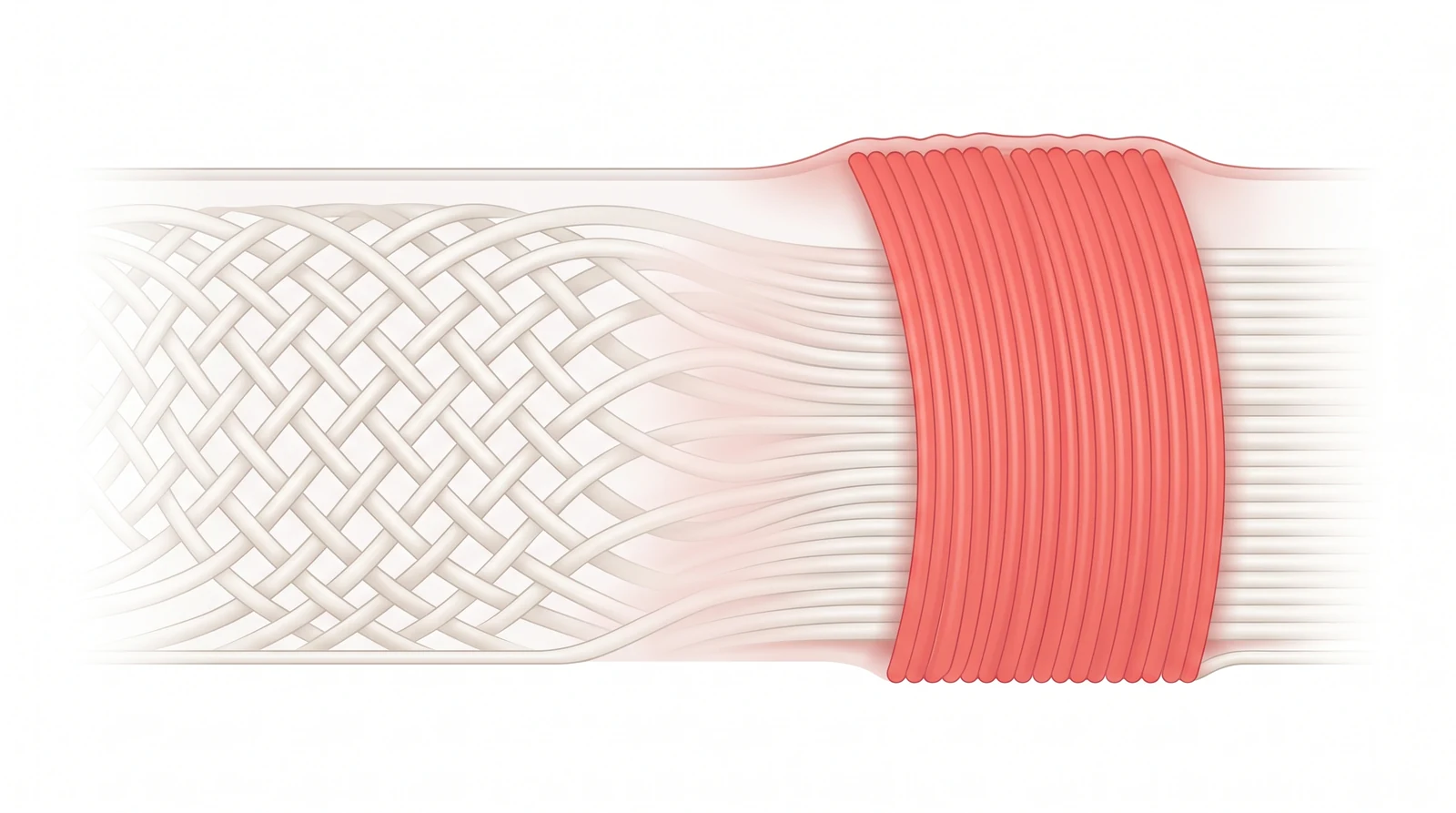
Why does a scar remain after a wound heals? Not because the body cannot repair perfectly, but because it chose speed over repair.
When skin tears deeply, the body has to close the site quickly first, because leaving it open increases the risk of infection. So instead of precisely restoring the original structure, it piles up collagen in haste to fill the gap.
The difference is in the arrangement. The collagen of normal skin is a mesh structure interwoven in many directions, so it flexes and holds no matter which way it is pulled. Scar collagen, by contrast, is packed densely in a single direction. It is the same material, woven differently.
That is why a scar looks and feels firmer than the surrounding skin, stretches less, and differs in color and texture.
Healing follows an order
Wound healing goes through several stages. First the bleeding stops and inflammatory cells gather to clear away foreign matter and dead tissue. This is the period of redness, swelling and heat.
Next, new tissue fills in. Fibroblasts produce collagen and microvessels grow in. During this period the scar becomes red and raised. It looks red because there are many blood vessels.
The last is the remodeling stage. The hastily piled collagen is broken down and rearranged, becoming a little more orderly. The blood vessels also decrease and the redness fades. This process continues for several months, and sometimes more than a year.
This is why time is emphasized in scar treatment. The red, raised state of the early period is not the final appearance.
Normal scars, hypertrophic scars and keloids
When the healing process concludes normally, a scar flattens and lightens in color over time. It does not disappear completely, but it settles into a less noticeable state.
There are cases where this process goes too far. A hypertrophic scar is a state in which collagen has piled up excessively so the scar rises, firm and red. However, it does not extend beyond the boundary of the original wound and tends to subside gradually over one to two years.
A keloid is different. It grows beyond the border of the original wound into normal skin, and it does not subside on its own with time. Constitutional factors are known to play a large part, so caution is needed where there is a family history.
Distinguishing the two matters because the approach changes. Simply cutting out a keloid can cause it to recur even larger.
| Category | Appearance and extent | Over time |
|---|---|---|
| Normal scar | Healing concludes normally, so it flattens and lightens in color | Does not disappear completely, but settles into a less noticeable state |
| Hypertrophic scar | Collagen piles up excessively, so it rises firm and red. Does not extend beyond the original wound | Tends to subside gradually over one to two years |
| Keloid | Grows beyond the border of the original wound into normal skin. Constitutional factors play a large part | Does not subside on its own, and simply cutting it out can cause it to recur even larger |
What makes a scar larger?
The depth of the wound comes first. Where only the epidermis is injured, almost no scar remains. The process of laying down new collagen begins only when the deep layer of the dermis is damaged.
Location is involved too. In places where the skin is constantly pulled, such as the shoulder, the chest and the joints, scars easily widen and thicken. Matching surgical incision lines to the direction of the skin creases is also a way of reducing this tension.
Results worsen when infection and inflammation persist. The longer the clearing stage lasts, the more collagen accumulates.
Ultraviolet light has an effect as well. If a healing scar is exposed to sunlight, pigment can be deposited and leave it dark. That is why sun protection is advised while a scar is healing.
Surgical scars are decided at the design stage
Unlike wounds from accidents, a surgical incision allows the position and direction to be chosen. So surgical scars are largely determined at the design stage.
First, direction. Skin has a grain, and incising along that grain means less force pulling the wound open while it heals. Cutting across the grain, by contrast, tends to widen the scar even at the same length.
Then there is position. Placing the incision line in a crease, at the hairline or where clothing covers it means that even if a scar remains, it is less noticeable. Hiding the incision lines around the ear and inside the hairline in a facelift is done for the same reason.
The suturing method matters as well. Rather than joining only the skin surface, distributing the tension across the deeper layers reduces the force on the surface. When the sutures are removed also affects the width of the scar.
Methods for making scars lighter
The most basic are moisture and compression. Silicone-based products and compression therapy are long-established methods that maintain moisture and reduce tension, working to keep collagen from piling up excessively. Consistency is the key, so they are continued over a span of months.
Injection therapy is used for red, thick scars. An agent that suppresses inflammation and collagen production is placed directly into the scar.
Lasers approach color and texture. There is a family that reduces redness and a family that smooths the surface, and treatment is carried out over several sessions.
Approaches using stem cells are also being tried. From the view that the problem of a scar ultimately lies in how the matrix is woven, the direction is to place autologous stem cells (SVF) obtained from fat directly into the scar to induce the tissue to reorganize. TheLINE Plastic Surgery carries out SVF scar treatment with this approach.
Acne scars have a different grain
Acne scars come up often. Unlike a cut, small irregularities are scattered across a wide surface, so the approach differs.
They are classified by shape. Narrow, deeply pitted forms, forms with rounded depressed borders, and wide, shallow depressed forms are each handled with different methods. In most cases several forms are mixed on one face, so a single method does not finish the job.
Deeply pitted areas are often tethered downward by fibrous bands underneath. Smoothing only the surface lets them be pulled back down, so releasing the adhesion first is mentioned as part of the process.
Pigmentation left behind must be distinguished from actual depressions. Marks left red or brown often lighten over time, but tissue that has genuinely been lost does not fill back in on its own.
Limits worth knowing
No method removes a scar completely. Rather than erasing a scar, making it less noticeable is the realistic goal.
Results vary greatly from person to person. Constitution, age, the location and depth of the wound, and the care taken during healing all play a part. Even with the same method, responses differ from person to person.
Time is needed too. Most methods are carried out over several sessions, and for a scar still in the remodeling stage we watch its course and choose the timing. Intervening too early can act as an irritant instead.
Injections, lasers and infiltration procedures all carry the possibility of swelling, pain, pigment changes and infection. If you are prone to keloids or have had a severe scar in the past, it is best to tell us in the consultation beforehand.
Frequently Asked Questions
My scar is red. Should I just leave it?
A healing scar has many blood vessels and looks red, and in many cases it lightens over time. However, if it steadily thickens or widens, it is worth having the course checked.
How do you tell a keloid from a hypertrophic scar?
The criterion is whether it goes beyond the extent of the original wound. A hypertrophic scar stays within the border and tends to subside over time, while a keloid grows into normal skin and does not subside on its own.
When should scar care begin?
It generally begins after the wound has closed completely. Irritating a wound that has not healed can interfere with healing, so the timing is confirmed in the consultation.
Can old scars improve?
Scars that have finished remodeling tend to show a smaller margin of change. Even so, there are methods that approach color and texture, so we judge based on the condition.
Is sun protection necessary for scars?
If a healing scar is exposed to sunlight, pigment can be deposited and leave it dark. Covering it with clothing or sunscreen is recommended.
What approach does TheLINE take to scar treatment?
TheLINE Plastic Surgery Clinic applies autologous SVF directly to the scar to induce the tissue to reorganize. However, the suitable method differs with the type of scar and when it formed, so we first check whether there is a tendency toward keloids. The goal is to make the scar less noticeable rather than to remove it entirely.