








A consensus has formed that for Korean medicine to expand globally and attract foreign patients, shared growth must be pursued through collaboration among related industries such as medicine, pharmaceuticals, medical devices and IT.
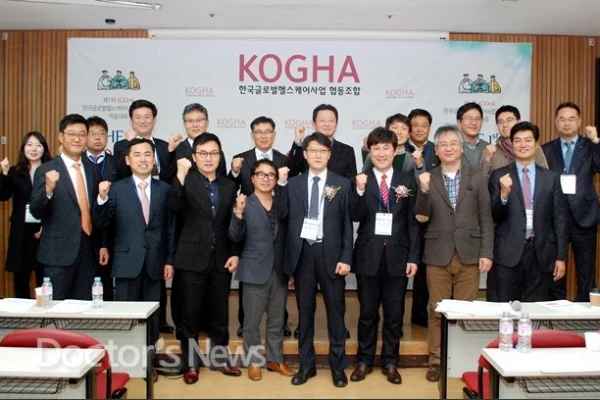
The Korea Global Healthcare Business Cooperative (KOGHA) and the Korea Brand Hospital Association (KBHA) held their first academic conference on the 20th at the auditorium of the Catholic University Institute of Biomedical Industry, on the theme 'Who Cut Open the Goose - K-Medical, the Korean medical wave and its challenges', seeking ways to bring about a second Korean medical wave.
Yeodong Yoon, chairman of the Korea Global Healthcare Business Cooperative (CEO of 21st Century Radiology Clinic and Polstar Global Co., Ltd.), said in his opening address, "For large hospitals, and even more so for small and mid-sized hospitals and clinic-level institutions, it is difficult to pursue foreign patient attraction or overseas expansion by working hard alone." He emphasized, "If the member companies of the Global Healthcare Business Cooperative come together, combine their strengths, and receive expert advice on legal, tax and investment matters, we can raise a new wave in the Korean medical wave through shared growth."
That day, KOGHA chairman Yeodong Yoon presented advisory appointment letters to Deloitte Anjin LLC (CEO Jongho Ham), Woorinuri Law Firm (managing attorney Jongwook Park) and Deuka Law Firm (managing attorney Sucheol Lee).
Chairman Yoon said, "We appointed financial, accounting and legal advisors to provide specialized support for members' overseas expansion and attraction of foreign patients," and added, "We are creating an environment in which member companies can grow together through cooperation."
Saying, "We are preparing to open an online shopping mall next year that will supply reliable products to member companies at low prices and be available for their use," Chairman Yoon added, "We are also pursuing ways to coexist and cooperate with the various cooperatives belonging to the Korea Federation of SMEs."
Dongwook Lee, Director General of the Health Industry Policy Bureau at the Ministry of Health and Welfare, said in his congratulatory address, "Under a plan to make Korea one of the world's seven leading bio-health powers and develop it into a new growth engine for the Korean economy, the government is supporting finance, taxation, consulting, licensing and marketing in order to expand Korean medicine globally and revitalize the attraction of foreign patients." He said, "We are creating new growth engines through the global branding of Korean medicine and the fostering of the pharmaceutical and medical device industries," and then asked, "We hope the Global Healthcare Business Cooperative will play a large role in raising the competitiveness of the healthcare industry."
The conference was attended by Sungbum Hong, director of Seoul Rigar Hospital, who opened a new path into China by establishing Seoul Rigar Hospital in Shanghai in 2011, and who introduced 'the process of establishing an overseas medical institution and its current operations'.
Director Hong assessed, "Since the introduction of national health insurance, the Korean medical community has faced many difficulties, given the public nature of hospitals and their high dependence on medical staff, as well as an environment in which reinvestment is impossible," and said, "The medical industry stands at a fork between closure and openness."
Noting, "No one would be pleased if a Japanese hospital came to Korea, set up a hospital and took money out. Because medicine has a public character, making money abroad is not easy," Director Hong said, "Approaching medicine as a business or thinking of it as an individual's way to make money is a sure path to failure," and advised, "Medicine, pharmaceuticals, equipment, personnel, culture and systems must seek to expand abroad together from an industrial perspective."
Director Hong explained, "China, which used to renew licenses once a year, has recently shown moves to tighten regulation into a residence permit format that recognizes a license only if the holder lives locally for half the year, as resistance grew within the local medical community over practicing without paying taxes." He said, "Because of regulation and tax issues in medicine, it is difficult to generate profit through hospital expansion alone, and industrialization that bundles Korea's excellent products and industries into a package is more advantageous."
Sangbae Han, CEO of MedUnion, said in 'The current state and problems of medical tourism', "Officially registered agencies for attracting foreign patients contribute to domestic industry through job creation, tax payments, guarantee insurance payments and legal compliance, whereas unregistered overseas operators take only commissions without contributing to domestic industry or bearing any obligations." He said, "The law on supporting overseas expansion and the attraction of foreign patients should be clarified so that registration is revoked when contracting with, referring to or brokering through unregistered attraction operators, and overseas unregistered operators should also be required to register, so that they contribute to domestic industry."
CEO Han pointed out, "Hospitals, which should be developing the industry in cooperation with attraction agencies, are instead competing with them, so the agencies are dying out," and said, "Attraction agencies and hospitals cooperating to open up overseas markets can grow the overall market in the long term."
Ilryong Son, head of the Overseas Medical Affairs Division at the Ministry of Health and Welfare, who presented on 'Policy direction for overseas medical expansion and the attraction of foreign patients', said, "The government plans to establish a mid- to long-term five-year plan for the bio-health industry and provide active support in order to spread the global expansion of Korean medicine and revitalize the attraction of foreign patients," and introduced measures including expanding package expansion of Korean medicine, revitalizing foreign patient attraction through medical tourism and IT convergence, region-specific strategies for global expansion, building global healthcare infrastructure, and raising the global standing of the Korean medical brand.
Participants in the panel discussion agreed, "What is most needed for overseas expansion and the attraction of foreign patients is to create a legal and institutional environment in which medical professionals can raise capital and invest," and said, "Current law permits management support organizations (MSOs), but if they exercise control over management and administration they inevitably become illegal proxy-owned hospitals," adding, "There is a need to open the door to a certain degree for overseas expansion and investment."
Geonyoung Ahn, director of Gowoonsesang Dermatology, who chaired the session, said, "What is frightening about China is that capital and medicine are combined there," and forecast, "On the basis of enormous capital, they are inviting skilled doctors and teaching techniques to local medical professionals. Five years from now, a situation could arise in which our citizens have to go to China for surgery."
Director Ahn said, "The time given to us is not long. We must gather ideas from now on to build a healthy medical ecosystem."
< Copyright: (c) Korean Medical Association Newspaper, Sungchul Song. Unauthorized reproduction and redistribution prohibited >